Police
Call 113.
Medical emergencies
Call 114.
Fire and rescue services
Call 116.

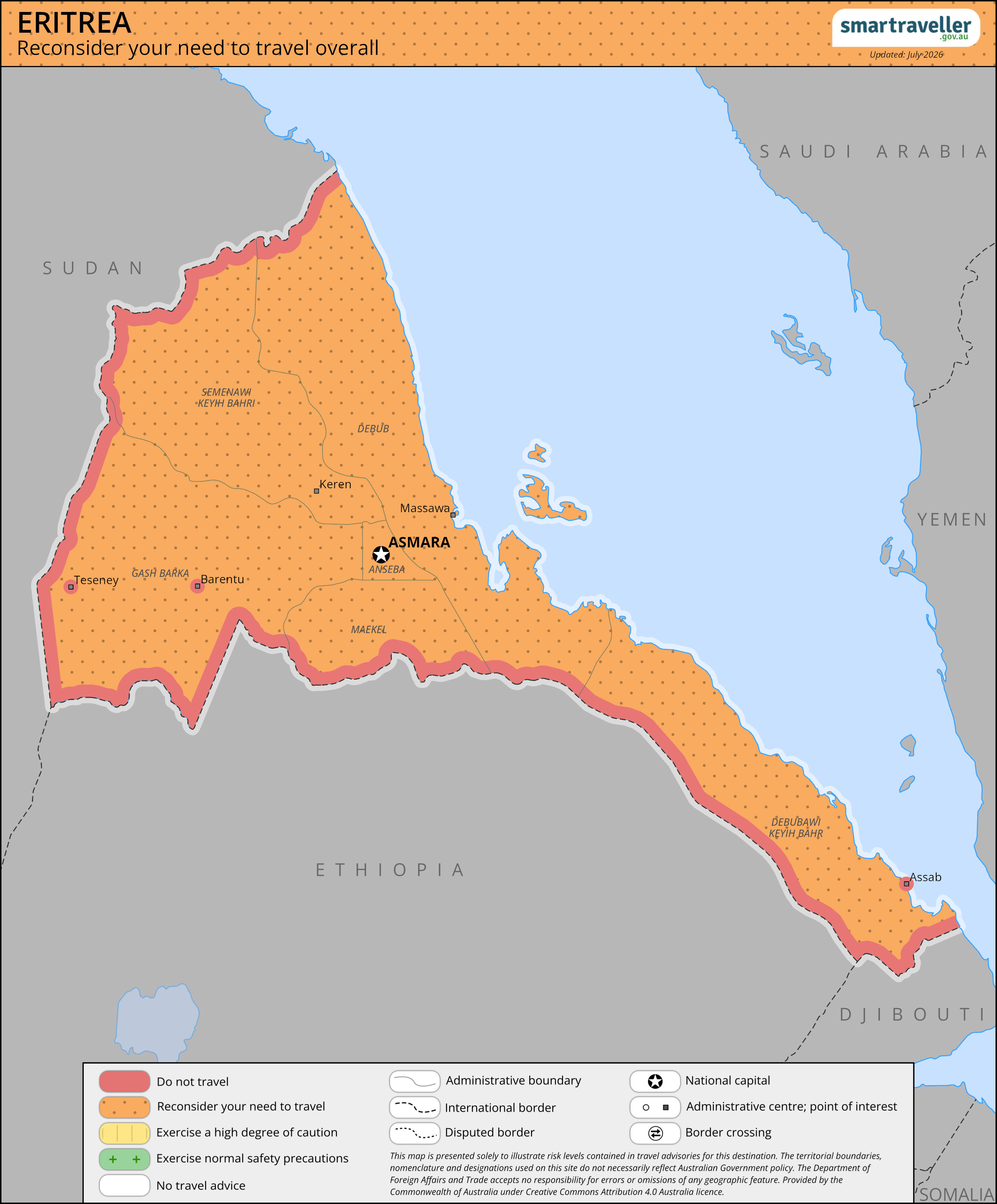
Reconsider your need to travel to Eritrea overall due to the risk of potential conflict with neighbouring countries.
Do not travel to the region bordering Ethiopia due to potential military activity and landmines on both sides of the border.
due to the high risk of robbery, violence, and armed groups operating in these areas.
Full travel advice: Safety
Full travel advice: Health
Full travel advice: Local laws
Full travel advice: Travel
Full travel advice: Local contacts
There is ongoing tensions and conflict with bordering countries. The security situation is unpredictable and could change quickly with little notice.
Monitor the media for updates that may affect your security and safety. Follow the advice of local authorities.
Recently heightened tensions in northern Ethiopia and between Ethiopia and Eritrea means further attacks are possible. In response to deteriorating relations with Ethiopia, the Eritrean Government called for a mobilisation of its armed forces in early 2025.
Tensions remain high, including due to the Ethiopian President's call for Ethiopian ownership of the Eritrean port of Assab. Additional security measures may be introduced at short notice. You should remain vigilant.
Eritrea has extensive unmarked minefields, mainly near the border with Ethiopia. Don't travel within 25km of the border.
All border crossings between Ethiopia and Eritrea are currently closed. Travellers should check local advice before proceeding to the border.
It's not clear where or to what extent de-mining has taken place. Walking and hiking in rural areas may be dangerous.
In most places, the border is neither marked nor obvious.
More information:
There have been reports of Eritrean involvement in the conflict in Sudan since its outbreak in 2023, especially in eastern Sudan near the border with Eritrea.
There's a high threat of robbery and violence from bandits and insurgents. There's ongoing reports of armed groups operating in and around the border area.
More information:
Despite normalising relations in 2018, tensions between Eritrea and Djibouti remain strained mainly due to historical border disputes. The risk remains high within 25km of the border. The situation could change quickly.
More information:
Kidnapping occurs across the world with political, ideological and criminal motives. Foreigners, including Australians, have been kidnapped overseas whilst travelling. Kidnapping can happen anywhere, even in places that seem safe.
Kidnapping is a risk in Eritrea. The risk is highest along Eritrea’s borders.
There is also a significant risk of piracy off the coast of Eritrea in the Gulf of Aden and the Red Sea.
If, despite our advice, you travel to an area with a high risk of kidnapping, our ability to provide assistance in these destinations is extremely limited.
You’re responsible for your own safety. You can find more information on how to reduce your risk of kidnapping here: Kidnapping.
The Australian Government’s longstanding policy is that it doesn’t make payments or concessions to kidnappers. Ransom payments to kidnappers have funded further terrorist attacks and criminal activity. Ransom payments to terrorist groups are likely to contravene Australian counter-terrorism financing laws.
More information:
There is a risk of street crime in Asmara. Avoid walking alone at night and keeping valuables secure.
Robbery and violence may occur:
There's a significant threat of piracy, ongoing insecurity and attacks on international shipping vessels and armed robbery in the Gulf of Aden and Indian Ocean.
Pirates have attacked vessels and held foreign nationals hostage for ransom in the Gulf of Aden.
Somali pirates have attacked vessels more than a thousand nautical miles (1850km) from the coast of Somalia.
Attractive targets for Somali pirates include:
You should remain out of the designated High-Risk Area or face the risk of being hijacked and held hostage for ransom.
If you need to travel by boat to Eritrea's waters and surrounds:
More information
No recent terrorist attacks have occurred in Eritrea, but they can happen.
Terrorist attacks could occur anywhere and at any time. Be alert to possible threats, especially in public places. Terrorists may target tourist areas or other places frequented by foreigners and where large crowds may gather.
Possible targets include:
To stay safe:
If there’s an attack, leave the area as soon as it's safe to do so.
Terrorism is a threat worldwide.
More information:
Eritrea is in an active volcano and earthquake zone.
Get information on natural disasters from the Global Disaster Alert and Coordination System. If a natural disaster occurs, follow the advice of local authorities.
In the rainy season from June to September, you may not be able to use unsealed roads in the western lowlands.
Ask your doctor about health risks and vaccines before you go.
Malaria occurs throughout the year in Eritrea.
Other insect-borne disease risks include:
There are no current reports of Zika virus outbreaks in Eritrea. However, there have been past outbreaks in Africa.
To protect yourself against diseases spread by insects:
Consider taking medicine to prevent malaria.
It may take some time to adjust to the high altitude and low oxygen levels of Asmara and surrounds.
If you suffer from a heart condition or high blood pressure, get medical advice before you travel.
HIV/AIDS is a risk for travellers. Take precautions if taking part in activities that put you at risk of infection.
Outbreaks of polio have occurred in countries across the Horn of Africa.
Check your polio vaccination status with your doctor or travel clinic at least 8 weeks before you travel. You may need a booster dose.
If you aren't vaccinated, complete the full course of vaccinations before you leave.
Waterborne, foodborne, parasitic and other infectious diseases are widespread. These diseases include:
Serious outbreaks sometimes occur.
To protect yourself from illness:
Get urgent medical help if you suspect food poisoning or have a fever or diarrhoea.
More information:
The medical care standard in Eritrea is extremely limited. Patients rely on family members for personal care and food. Adequate medical equipment may not be available for serious illness or injury.
Asmara has three public hospitals, while other towns have fewer facilities and medical resources are even more limited elsewhere.
Medicines are often unavailable and can be expensive. Carry a full medical pack if you travel away from large towns.
If you become seriously ill or injured, you may need to be evacuated to a place with better facilities. Medical evacuation can be very expensive.
In the past, Eritrean authorities have refused consular access to detained foreigners.
The Australian Government may not be able to provide fast or full consular help to Australians held in Eritrea.
Penalties for drug-related crimes are severe and include long prison sentences.
More information:
Serious crimes may attract the death penalty or physical punishment.
In Eritrea it's illegal to:
More information:
Eritrea doesn't recognise dual nationality.
If you're a dual national, this limits the consular services we can give if you're arrested or detained.
Always travel on your Australian passport.
Australian males who hold Eritrean citizenship may need to enter military service when they return to Eritrea.
Dual nationals who enter on an Eritrean identity card rather than an Eritrean passport will need an exit visa from the Immigration Office in Asmara.
If you're an Eritrean-Australian dual national, get advice from the nearest embassy or consulate of Eritrea before you travel.
More information:
Standards of dress and behaviour are strict in Eritrea. Take care not to offend. If in doubt, ask for local advice.
You'll need a visa to enter Eritrea.
Entry and exit requirements can change at short notice. Contact the nearest embassy or consulate of Eritrea for details about visas, currency, customs and quarantine rules.
International flights into and from Asmara are limited. Check with your airline.
You need an exit permit to leave Eritrea. It can take a long time to get one. The Immigration Department may deny you a permit.
The Australian Government cannot influence the Eritrean Immigration Department to issue exit permits.
You must pay a departure tax in US dollars. You're exempt if you hold a valid Eritrean resident permit. Ask local authorities about the cost of the departure tax because the amount may change.
You may need a valid yellow fever vaccination certificate to enter Eritrea, especially if you're arriving from a country where yellow fever is common. You'll also need to have one when you leave.
Most countries ask for proof of yellow fever vaccination if you arrive from Eritrea and other yellow fever risk countries. This includes Egypt and South Africa.
Find out about returning to Australia after exposure to yellow fever.
More information:
Declare all electronic items when you arrive. These include:
If you don't declare them, Eritrean customs officials could confiscate the items when you leave.
The local currency is the Eritrean Nakfa (ERN). Currency controls are in place.
There's no limit to the amount of foreign currency you can bring into the country. This covers all forms of currency, not only cash. Make sure you have had your complete foreign currency declaration form approved and stamped before you leave the airport.
Any foreign currency used in Eritrea must be exchanged or used legally. You must have proof of this when you leave.
Eritrea's economy is completely cash-based. There are no credit card or ATM facilities in Eritrea. You'll need to pay for everything in cash, except in some hotels. Check with your hotel before travelling to find out the best way to pay.
It's illegal to change money anywhere other than at a branch of the state foreign currency exchange in one of the 'Himbol' exchanges in town. Some officially recognised hotels can accept foreign currency. Otherwise, it's illegal to use foreign currencies in Eritrea.
You can't take more than 500 Nakfa out of Eritrea. Authorities could prosecute you if you do. Nakfa aren’t convertible outside Eritrea. You should convert any excess Nakfa back to hard currency at one of the 'Himbol' exchanges in town, as there are limits to what can be converted at the 'Himbol' branch at the airport. You will need the original currency transaction receipt.
Landline, mobile telephone and internet services are unreliable. Internet is available at some international hotels and internet cafes in Asmara.
Local SIM cards are difficult to obtain and may not be available to non-residents.
Eritrean mobile phone providers don't have agreements with international providers. International roaming may not be available.
Contact your telecommunication provider before travelling.
You must apply ahead for a travel permit to travel 25km outside of Asmara and the surrounding province of Zoba Maekel. Ministries in Asmara process applications.
The Ministry of Trade and Industry handles business travel applications.
The Ministry of Tourism on Harnet Avenue in Asmara handles tourist travel applications.
Apply in advance as processing applications may take several days.
When applying for permission to travel outside of Asmara, give details of your car.
If you're living or working outside of Asmara and want to travel outside your normal area of work or home, you need a travel permit. Apply at your local Zonal Administration Office. Travel applications can take several days to process. Sometimes they're refused or delayed.
Our consular services are severely limited outside Asmara. This includes emergency assistance. Australian consular officials often face long delays to get visas to enter Eritrea. Once in Eritrea, Australian officials must then apply for a permit to travel outside Asmara.
To drive in Eritrea, you must get an International Driving Permit (IDP) before you arrive. Otherwise, contact local authorities to get a local licence.
There are extensive mine fields in Eritrea, especially in border areas. Driving on main roads outside of border areas is generally safe. Driving on rural roads and off-road driving can be dangerous. Avoid travel after dark in rural areas. Road signage and barriers are scarce, and steep drops are common. In many parts of the country roads are difficult or impassable during the rainy season.
Roads are sealed between the cities of Asmara, Massawa, Mendefera, Dekemhare, Baretun and Keren. Roads leading to smaller villages are unsealed.
Road maintenance isn't consistent in mountainous regions and steep sloping areas. Rock falls are common. Narrow winding roads with crumbling edges often don't have safety barriers.
More information:
Avoid using motorcycles, particularly in rural areas where standards of driving and road maintenance are lower.
Check with your travel insurer to see if your policy covers riding a motorcycle.
Always wear a helmet.
Use only licensed taxis or reputable limousine services. You can arrange this through your hotel.
There are no internationally recognised rideshare apps operating in Eritrea.
Maintenance standards on buses may be lower than in Australia.
Travellers are sometimes not allowed to use public transport to travel outside of Asmara. You may need to rent a car or use a private taxi.
More information:
Before you arrive, you must get permission and an entry visa to arrive in Eritrea by sea.
Commercial vessels that don't have agreements with Eritrean authorities should avoid Eritrean territorial waters. The Eritrean government has taken control of ships that didn't have an agreement. This has led to lengthy detention for international crew members.
Piracy is a high threat in the coastal areas of Eritrea. Pirate attacks happen against all forms of vessels in and around Eritrea's waters and the Gulf of Aden (see 'Crime').
All forms of shipping are attractive targets for Somali pirates, including commercial vessels, yachts and luxury cruise liners. Stay alert and take extra precautions when anywhere near these waters.
More information:
Check Eritrea's air safety profile with the Aviation Safety Network.
More information:
Depending on what you need, contact your:
Emergency services and the telephone network in Eritrea are unreliable but they exist.
Call 113.
Always get a police report when you report a crime.
Your insurer should have a 24-hour emergency number.
Call 114.
Call 116.
There are limits to what consular assistance we can provide in high-risk locations. Read the Consular Services Charter to understand how we can assist you overseas.
The Australian Government may not be able to provide consular help if you're detained in Eritrea. Eritrean authorities don't always tell the relevant embassy when foreign nationals need consular help.
Australia doesn't have an embassy or consulate in Eritrea. The Australian Embassy in Cairo provides consular services to Australians in Eritrea.
Australian consular officials often face long delays in getting visas to enter Eritrea or to travel outside of Asmara. These delays severely limit consular help to Australians in Eritrea, especially outside of Asmara.
The Eritrean authorities may not inform the relevant Embassy if a foreign national is in need of help and there have been recent instances where the Eritrean authorities have refused consular access to foreign nationals.
If you need consular help, contact the Australian Embassy in Cairo.
11th floor, World Trade Centre
1191 Corniche el Nil
Boulag, Cairo, Egypt
Telephone: +20 2 2770 6600
Website: egypt.embassy.gov.au
X: @AusAmbEGY
Facebook: Australian Embassy in Egypt
Check the Embassy website for details about opening hours and any temporary closures.
In a consular emergency, if you can't contact an embassy, call the 24-hour Consular Emergency Centre on:
Be the first to know official government advice when travelling.